Our products · Rolls

Rolls for every stand of the mill

From clear chill cast iron to high speed steel — each grade matched to its place in the rolling schedule.

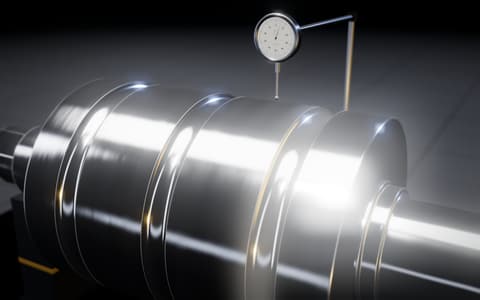
3D view of a finished grooved roll on V-blocks, checked with a dial gauge
A finished roll, checked to size

At a glance

Which roll for which stand

A rolling mill works the bar in three steps. Point to a roll family to see the stands it serves.

Roughing stands

Heavy passes, high loads

Intermediate stands

Shape and size take form

Finishing stands

Final size and surface

Other duties

Mixed schedules, cold rolling and general work

Point to a roll family to see its stands.

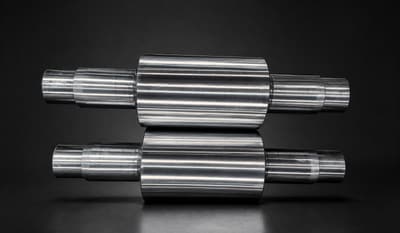
Two clear chill cast iron rolls on a dark background

01Finishing stands

Clear Chill / Definite Chill Cast Iron Rolls

White graphite-free working surface for excellent wear resistance.

  • Eutectic carbide surface
  • 2-3-4 high mills
  • Sheet · strip · sections
Read more

The working surface shows a white, graphite-free structure of eutectic carbide and transformed austenite — a hard layer with excellent wear resistance. Flake graphite is embedded in a pearlite matrix containing about 0.08% combined carbon. Compared to grey iron, white chill iron has greater hardness, better wear resistance and high compressive strength, making excellent work rolls for two-, three- and four-high mills turning out high-grade ferrous and non-ferrous sheet, strip and sections.
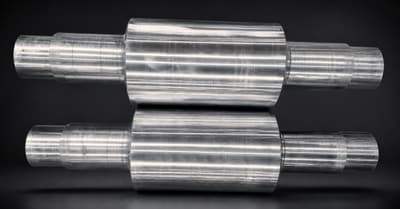
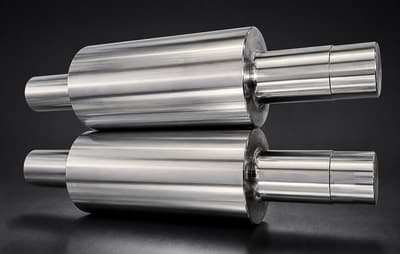
Two alloy cast steel rolls on a dark background

02Roughing stands

Alloy Cast Steel Rolls

Heat-treated steel for heavy passes in roughing stands.

  • C 0.50–1.20%
  • Double annealed + tempered
  • Heavy passes
Read more

Carbon content in the range of 0.50% to 1.20%. Heat treatment gives a spheroidised or fine pearlite matrix for high toughness, with small areas of carbide increasing wear resistance. Normal double annealing followed by a tempering cycle improves toughness and thermal shock resistance. The microstructure is primarily pearlitic with broken cementite — mechanical strength of a higher degree with good weldability.

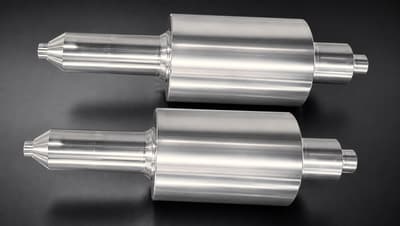
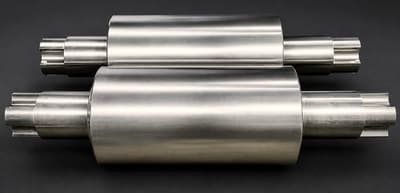
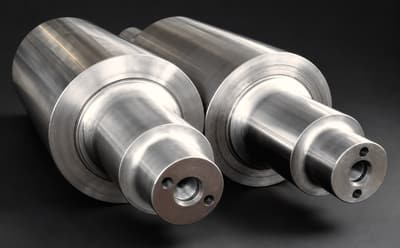
Two double poured indefinite chill rolls, neck ends facing the camera

03Intermediate · finishing

Double Poured Indefinite Chill Rolls

Duplex double-pour casting: hard shell, tough core.

  • Centrifuged alloy shell
  • Grey / SG iron core
  • Uniform shell thickness
Read more

A highly alloyed centrifuged shell as the working layer over a core of grey iron or SG iron, depending on mill requirements. The shell microstructure — carbide and graphite in a matrix progressing from pearlite and bainite through to martensite in harder grades — gives wear resistance controlled by proper dispersion of graphite and carbides. Compared to statically cast double poured rolls: less average hardness drop, a more uniform compact shell, and lower core alloy content imparting higher toughness.

Two adamite rolls on a dark background

04Roughing · section mills

Adamite Rolls

Steel-base adamite grades for roughing stands and section mills.

  • C 1.0–2.2%
  • Carbides in pearlite
  • Section & bar mills
Read more

Widely used for hot rolling in pre-roughing and roughing group stands, and at different positions in section mills. The material consists of carbides in a pearlitic matrix with carbon between 1.0 and 2.2%. Depending on primary requirements, a variety of grades with a series of carbon contents and alloying elements are used, matched to mill conditions of wear, strength and thermal cracking.

Two multi rolls with centre-drilled necks on a dark background

05Mixed schedules

Multi Rolls

Multi-grade rolls tailored to mixed rolling schedules.

  • Tailored composition
  • Varied sections
Read more

Multi-grade rolls tailored to mixed rolling schedules where a single stand sees varied sections and materials — composition and chill depth adjusted to the customer\u2019s pass design.

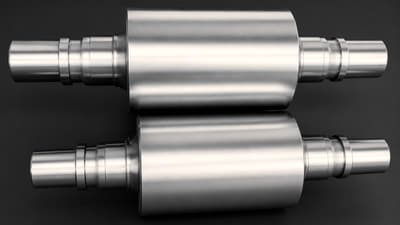
Two EN-grade forged steel rolls on a dark background

06Cold rolling · high duty

EN-8 / EN-9 / EN-42 Forged Rolls

Forged steel rolls for demanding mill applications.

  • EN-8 · EN-9 · EN-42
  • Work & back-up rolls
  • Cold rolling
Read more

Forged rolls made with centre holes for heat treatment and inspection — specified primarily for work rolls, back-up rolls, auxiliary and special rolls. Typical composition 0.85 C, 0.30 Mn, 0.30 Si, 1.75 Cr, 0.10 V, with molybdenum added and chromium varied for specific characteristics. Cold rolling involves extremely high pressures, and forged rolls deliver the strength, quality and wear resistance it demands — preferred in non-ferrous hot mills over iron rolls for their higher bending strength and resistance to metal pickup.

Two spheroidal graphite iron rolls on a dark background

07Roughing · intermediate

Spheroidal Graphite Iron Rolls (SGI)

SG iron combining strength with thermal resistance.

  • UTS > 40 kg/mm²
  • Deep hardness
  • Pilger rolls
Read more

SG (ductile) iron is one of the most versatile roll materials today, with greatly improved properties including tensile strength above 40 kg/mm² against 20–30 kg/mm² for cast iron. Specifically good for small section and flat rolling, and most suitable for heavier sections where added strength and depth of hardness are required. Stand-cast acicular SG iron is employed for special-purpose rolls such as pilger rolls.

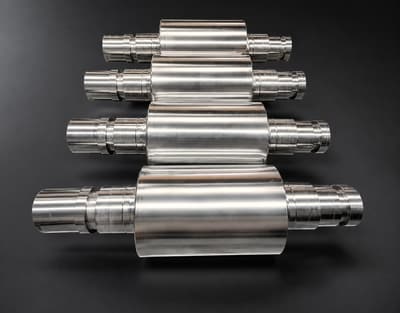
Four SG acicular rolls stacked on a dark background

08Intermediate · finishing

SG Acicular Rolls (SGACC)

Acicular SG structure for superior wear performance.

  • Martensitic-bainitic matrix
  • Superior wear life
Read more

Nodular acicular rolls widely used for hot rolling in intermediate, prefinishing and finishing group stands. The material consists of nodular graphite and carbides in a martensitic and bainitic matrix — more wear resistant than nodular pearlitic rolls. Standard and higher-alloyed variants are chosen per mill conditions, where wear resistance increases with hardness drop against standard grades for the type of groove or calibre.

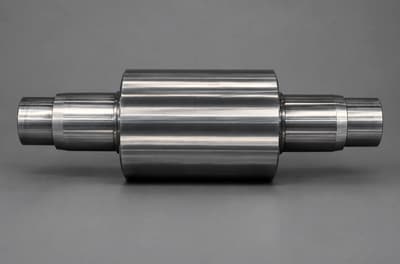
A machined high speed steel roll with stepped necks on a grey background

09Intermediate · finishing

High Speed Steel Rolls (HSS)

Centrifugally cast high speed steel shell for the longest wear life.

  • Cr · Mo · V · W shell
  • MC carbides
  • Long campaigns
Read more

A centrifugally cast shell of high speed steel over a tough core of SG iron or forged steel. The shell is alloyed with chromium, molybdenum, vanadium and tungsten (typically C 1.6–2.3%) and hardened to form very hard MC carbides in a tempered martensite matrix. This gives several times the wear life of indefinite chill or SGACC rolls, a stable roll surface through long campaigns, and good resistance to thermal cracking — used in intermediate and finishing stands of hot strip, bar and wire rod mills.

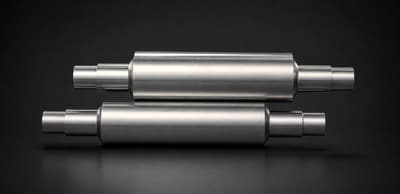
A pair of machined metal rolls on a dark background

10General applications

Metal Rolls

General-purpose metal rolls for varied applications.

  • To customer spec
  • Varied applications
Read more

General-purpose metal rolls manufactured to customer specification for varied rolling and processing applications beyond the standard grades.

Production process

From melt to mill, step by step

Three routes, one standard. Pick a route to follow a roll from the charge mix to dispatch.

Route

Centrifugal cast rolls

A double-poured sleeve, shrink-fitted onto a steel shaft.

  1. Charge mix

    Tested scrap, pig iron and alloys, weighed to the grade.

  2. Melting

    The melt is analysed and balanced to the grade's chemistry.

  3. Centrifugal casting

    Double pour in a spinning mould: a hard shell, then a tough inner layer.

  4. Heat treatment

    Hardening and tempering on a controlled temperature cycle.

  5. Proof machining

    A first cut shows that the metal is sound.

  6. Shrink fit

    The heated sleeve grips the shaft as it cools.

  7. Necks & grooves

    Necks, faces and pass grooves cut to the mill's drawing.

  8. Grinding

    A final grind brings the barrel to size and finish.

  9. Testing

    Hardness, soundness and balance checked before release.

  10. Certificate & dispatch

    Packed with its test certificate, for India and abroad.

Static cast rolls

Cast in one piece in a chill mould.

  1. Charge mix

    Pig iron and foundry returns, weighed for each heat.

  2. Melting

    Tapped into the ladle once the chemistry is right.

  3. Static casting

    Poured into a chill mould that freezes a hard working face.

  4. Heat treatment

    Hardening and tempering on a controlled temperature cycle.

  5. Rough machining

    Barrel and necks turned close to size.

  6. Necks & wobblers

    Necks, faces and wobblers shaped to the mill's drawing.

  7. Grinding

    A final grind brings the barrel to size and finish.

  8. Testing

    Shore hardness mapped across the barrel.

  9. Certificate & dispatch

    Rested on timber saddles and strapped, with its certificate.

Forged rolls

A steel ingot, forged under the press, then hardened and machined.

  1. Charge mix

    Steel scrap and alloys, weighed into the charge.

  2. Melting

    Sampled and adjusted in the ladle before pouring.

  3. Ingot casting

    Clean steel poured into an ingot mould.

  4. Forging

    The hot ingot is pressed to shape, closing the grain.

  5. Heat treatment

    Hardening and tempering on a controlled temperature cycle.

  6. Rough machining

    The forged skin is turned away to clean metal.

  7. Necks & faces

    Necks and faces turned to the mill's drawing.

  8. Grinding

    Ground to a fine finish under coolant.

  9. Testing

    Microstructure and hardness checked against the grade.

  10. Certificate & dispatch

    Crated and lifted with care, with its certificate.

With every roll

  • Made to your drawing

    Barrel profile, grooves, necks and wobblers as drawn.

  • Test certificate

    Grade, chemistry, hardness and balance on record.

  • Warranty

    Rolls conform to the agreed specification.

  • Dispatch

    Packed for transport across India and abroad.

Roll anatomy

Every zone engineered for its job

Half-section drawing of a roll: wobblers at both ends, the journal and necks, the neck fillets, the barrel with three pass grooves, and, cut open in the lower half, the chilled shell over the grey iron core. Barrel length and overall length are marked.

Roll part

Choose a part

Each zone of a roll has its own job. Choose a number on the drawing, or a part in the list.

Wobbler
The drive end. Its flats take the turning force from the mill's spindle coupling.
Journal
The drive-side neck, machined to run true in the bearing.
Neck fillet
The curve where the neck meets the barrel. A smooth radius spreads the load and helps prevent cracks.
Pass grooves
The profiles turned into the barrel that shape the bar or section, pass by pass, to the customer's drawing.
Chilled shell
The hard, wear-resistant working layer. Its hardness and depth are set by the grade and checked before dispatch.
Grey iron core
The tougher inside of the roll. It carries the bending and shock loads that a hard shell alone could not.
Neck / bearing seat
The tending-side neck, machined to fit the bearing and hold the roll in line.

Parts of a roll, in half section. Choose a part to see what it does.

Metallurgy

Chemical composition

Pick a grade to see its alloy content, strength and hardness. Compare it with a second grade if you like.

Grade
Steel
SG iron
Chilled iron
Double pour
High speed steel
Alloy content, % by weight

Indefinite chill

  • CCarbon 3.00–3.50
  • SiSilicon 0.80–1.50
  • MnManganese 0.55–1.20
  • CrChromium 0.80–1.40
  • NiNickel 1.45–2.50
  • MoMolybdenum 0.25–0.45
Strength and elongation
  • Tensile strengthkg/mm² 20–30
  • Elongation% 0.20–0.25
  • HardnessShore C 55–75
Hardness of every grade, Shore C

Choose a bar to see that grade above.

≤ means “up to”: the grade sets an upper limit only. Ranges as published in our works catalogue and grade sheets — exact composition is tailored to each customer's rolling application and confirmed at order with certified analysis.

Show all numbers as a table
Chemical composition and properties by roll grade
Roll gradeC %Si %Mn %Cr %Ni %Mo %U.T.S. kg/mm²Elong. %Shore C (HSC)
ACS — Alloy Cast Steel0.50-1.500.30-0.600.75-1.150.75-1.151.00 Max0.20-0.4060-904.00 Max30-45
ASB — Adamite Steel Base1.50-2.000.30-0.600.80-1.500.80-1.501.50 Max0.20-0.5060-904.00 Max45-55
SG Iron — Pearlitic2.90-3.401.40-2.500.50-0.700.15-0.351.50-2.000.25-0.6038-620.50-0.8045-55
SG Iron — Pearlitic (hard)2.20-3.501.20-1.900.60-0.900.25-0.501.50-2.500.25-0.6038-620.50-0.8055-65
SG Iron — Acicular3.20-3.501.20-1.700.50-0.700.30-0.702.00-3.000.70-1.1040-651.00-2.0065-75
SG Iron — Acicular (hard)3.25-3.551.20-1.500.50-0.700.30-0.802.80-4.000.70-1.2040-651.00-2.0075-80
Indefinite Chill3.00-3.500.80-1.500.55-1.200.80-1.401.45-2.500.25-0.4520-300.20-0.2555-75
Definite Chill3.00-3.400.20-0.900.20-0.500.20-0.501.00-2.000.25-0.3520-270.20-0.2555-70
Definite Chill (hard)3.20-3.600.20-0.800.20-0.600.20-0.501.70-2.500.25-0.4020-270.20-0.2570-75
Non Metal3.00-3.800.20-0.500.20-0.600.30-0.800.50-2.000.10-0.3020-250.20-0.2565-75
DP Shell — Grade I3.15-3.400.80-1.200.50-1.001.30-1.600.50-4.100.25-0.40——70-75
DP Shell — Grade II3.20-3.450.80-1.200.60-1.001.30-1.703.00-4.250.25-0.40——75-80
DP Shell — Grade III3.30-3.500.80-1.200.65-1.101.40-2.003.50-4.500.25-0.40——80-85
GI Core (double pour)3.00-3.501.50-2.500.45-0.600.60 Max——20-300.20-0.2535-45
SG Core (double pour)3.00-3.401.90-2.700.50 Max0.60 Max——35-500.50-0.6535-45
HSS — Grade I1.80-2.300.50-1.000.30-0.804.50-5.000.50-1.004.50-5.00——75-80
HSS — Grade II1.60-2.300.30-0.900.20-0.803.00-6.00—3.00-6.00——75-80

HSS — Grade I also: W 1.00–2.00 · V 5.00–5.50 %.

HSS — Grade II also: W 1.00–4.00 · V 2.00–6.00 · Nb 1.00–3.00 · S ≤ 0.03 %.

Steel rolls as-cast without heat treatment are not suitable for rolling — dendritic structure, coarse grain, non-homogeneity and internal stresses make them poor in mechanical properties. Our steel rolls are therefore subjected to precisely calculated and controlled heat treatment, distributing cementite and ferrite evenly while retaining the pearlitic base structure. Such rolls trade a small decrease in hardness for higher strength, making them suitable for heavier passes and severe stress in roughing and intermediate stands.

Product specification

Recommended roll quality by mill & product

Barrel hardness in Shore C (HSC). "—" means the grade is not listed for that stand.

ACS
Alloy Cast Steel
ASB
Adamite Steel Base
SG(P)
SG Iron Pearlitic
SG(A)
SG Iron Acicular
CC
Clear Chill
IC
Indefinite Chill
DPIC
Double Poured Indefinite Chill
HSS
High Speed Steel
Flat products for steel mills27 rows
Recommended barrel hardness (Shore C) for flat products for steel mills
Rolled product Type of mill StandsACSASBSG(P)SG(A)CCICDPICHSS
SlabsUniversal Horizontal35-40———————
Vertically35-4045-50——————
High Lift —35-40———————
Wide Hot StripVertical Skelp-Breaker35-4045-50——————
Horizontal Skelp Breaker35-40———————
2 High Roughing35-40———————
4 High Continuous Roughing work roll34-4045-50————65-70—
4 High Reversing Roughing work roll—50-55——————
Vertical Attached Edgers40-4545-55——————
Continuous Early stands work roll—45-50————65-7575-80
Finishing Train Late stands work roll—————70-7575-8075-80
4 High Reversing Steckel work roll——————70-8075-80
Continuous & Reversing Back up—45-55——————
2 High Skin pass——————80-85—
4 High Skin pass work rolls——————80-85—
Cold Strip4 High Reduction Work roll——————80-85—
Back up—50-55———65-75——
4 Temper Work roll——————80-85—
Back up——60-65———70-75—
Plates2 High Roughing35-4045-5545-65—————
Finishing—50-5560-6560-6560-6560-6570-75—
3 High —————65-7060-6570-75—
Roughing work roll——55-60——60-6570-75—
4 High Finishing work roll——60-6570-8065-7565-6560-8075-80
Back up—45-5045-55—————
Sheet2 & 3 High Roughing35-4045-5560-65—65-7060-6560-65—
Finishing——60-6565-7565-7060-6565-70—
Shaped products for steel mills18 rows
Recommended barrel hardness (Shore C) for shaped products for steel mills
Rolled product Type of mill StandsACSASBSG(P)SG(A)CCICDPICHSS
Billets, Bars & Round2 & 3 High Roughing30-4045-5555-60——55-60——
Finishing35-4045-5560-65——60-65——
Medium Sections2 & 3 High Roughing30-40———————
Intermediate40-4545-5550-60——55-60——
Finishing—50-5560-6565-70—60-70——
Light Section Bar2 & 3 High Roughing35-4545-5045-55—————
Intermediate—50-5555-6065-70—55-6065-70—
Finishing—50-5560-6570-75—60-7570-7575-80
Tube2 High Pilger35-45———————
BilletsContinuous Roughing40-4545-5050-55—————
Intermediate—50-5555-60——55-60——
Finishing——60-65——60-70——
Medium & Light SectionsContinuous Roughing35-45—50-60——50-60——
Intermediate—45-5055-60——55-6565-7075-80
Finishing—45-5560-6570-80—60-7070-8575-80
Wire RodContinuous Roughing40-4545-5045-55—————
Intermediate——55-60—55-6555-7065-7575-80
Finishing——60-6570-8065-7560-7570-8575-80
Rolls for non-ferrous metals7 rows
Recommended barrel hardness (Shore C) for rolls for non-ferrous metals
Rolled product Type of mill StandsACSASBSG(P)SG(A)CCICDPICHSS
Slabs2 High Roughing40-4545-50——————
4 High Roughing Work roll—50-5545-55—————
Backup roll40-45———————
4 High Finish Work roll———65-75——70-85—
Backup roll—50-5555-65—————
Shaped Products2 & 3 High Roughing40-4545-5550-60—————
2 High Finishing——60-6570-8070-7560-7070-80—

Rolls are manufactured to customer drawings — barrel profile, groove design, neck and wobbler dimensions as specified. Share your drawing for an exact quotation.

Not sure which grade fits your stand?

Send us your mill configuration — we'll recommend the right roll.