
Roll family 02 · Roughing stands
Alloy Cast Steel Rolls
Heat-treated steel for heavy passes in roughing stands.
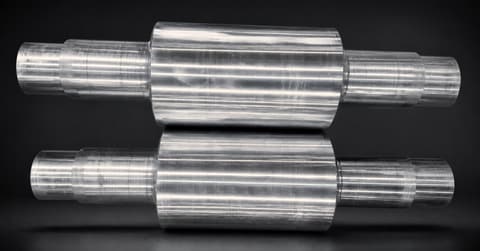
About this roll
Alloy cast steel rolls: the material
Carbon content in the range of 0.50% to 1.20%. Heat treatment gives a spheroidised or fine pearlite matrix for high toughness, with small areas of carbide increasing wear resistance. Normal double annealing followed by a tempering cycle improves toughness and thermal shock resistance. The microstructure is primarily pearlitic with broken cementite — mechanical strength of a higher degree with good weldability.
Where it works
Its place in the mill
-
Roughing: used here
Heavy passes, high loads
-
Intermediate: not usual here
Shape and size take form
-
Finishing: not usual here
Final size and surface
Metallurgy
Composition and properties
Ranges from our grade sheets. The exact composition is set for each order.
| Grade | C % | Si % | Mn % | Cr % | Ni % | Mo % | U.T.S. kg/mm² | Elong. % | Shore C (HSC) |
|---|---|---|---|---|---|---|---|---|---|
| ACS — Alloy Cast Steel | 0.50-1.50 | 0.30-0.60 | 0.75-1.15 | 0.75-1.15 | 1.00 Max | 0.20-0.40 | 60-90 | 4.00 Max | 30-45 |
- Alloy cast steel 30–45
- Grey iron core 35–45
- SG iron core 35–45
- Adamite steel base 45–55
- SG pearlitic 45–55
- SG pearlitic (hard) 55–65
- Definite chill 55–70
- Indefinite chill 55–75
- SG acicular 65–75
- Non metal 65–75
- Definite chill (hard) 70–75
- DP shell I 70–75
- SG acicular (hard) 75–80
- DP shell II 75–80
- HSS I 75–80
- HSS II 75–80
- DP shell III 80–85
Recommended use
Where we recommend it
Mills and stands where this roll is the usual choice, with the barrel hardness we recommend.
| Rolled product | Type of mill | Stand and barrel hardness, Shore C |
|---|---|---|
| Flat products for steel mills | ||
| Slabs | Universal |
|
| Slabs | High Lift |
|
| Wide Hot Strip | Vertical |
|
| Wide Hot Strip | Horizontal |
|
| Wide Hot Strip | 2 High |
|
| Wide Hot Strip | 4 High Continuous |
|
| Wide Hot Strip | Vertical |
|
| Plates | 2 High |
|
| Sheet | 2 & 3 High |
|
| Shaped products for steel mills | ||
| Billets, Bars & Round | 2 & 3 High |
|
| Medium Sections | 2 & 3 High |
|
| Light Section Bar | 2 & 3 High |
|
| Tube | 2 High |
|
| Billets | Continuous |
|
| Medium & Light Sections | Continuous |
|
| Wire Rod | Continuous |
|
| Rolls for non-ferrous metals | ||
| Slabs | 2 High |
|
| Slabs | 4 High Roughing |
|
| Shaped Products | 2 & 3 High |
|
Production process
From melt to mill
Static cast rolls
Cast in one piece in a chill mould.
-
Charge mix
Pig iron and foundry returns, weighed for each heat.
-
Melting
Tapped into the ladle once the chemistry is right.
-
Static casting
Poured into a chill mould that freezes a hard working face.
-
Heat treatment
Hardening and tempering on a controlled temperature cycle.
-
Rough machining
Barrel and necks turned close to size.
-
Necks & wobblers
Necks, faces and wobblers shaped to the mill's drawing.
-
Grinding
A final grind brings the barrel to size and finish.
-
Testing
Shore hardness mapped across the barrel.
-
Certificate & dispatch
Rested on timber saddles and strapped, with its certificate.
- Your roll drawing, or barrel and neck sizes
- Mill type and the stand for the roll
- Material rolled and the pass or groove
- Quantity and the date you need it
Our range
Other roll families
- 01 Clear chill rolls Finishing stands
- 03 Indefinite chill rolls Intermediate · finishing
- 04 Adamite rolls Roughing · section mills
- 05 Multi rolls Mixed schedules
- 06 Forged rolls Cold rolling · high duty
- 07 SG iron rolls Roughing · intermediate
- 08 SGACC rolls Intermediate · finishing
- 09 HSS rolls Intermediate · finishing
- 10 Metal rolls General applications
Need this roll for your mill?
Send your drawing or roll size — we will quote by return.